Level 1 of 5
Function
What the mechanism does. The largest area from the smallest protected stow, measured from the wing at rest and in flight.
A surface that collects only when it is useful, and is safe when it is not.
Mattara Energy + Motion
We practise bionic design. We study how living things fold, open and gather energy, and we design products, places and systems that work the same way.
WS1 Australian plague locust, Chortoicetes terminifera
The hindwing is pleated like a fan and stowed beneath a narrow, leathery forewing. It opens from one hinge to almost ten times its folded footprint.
The studio
We design the surfaces that gather energy and the mechanisms that open and stow them, for products, vehicles and places. We learn each mechanism from a living thing, and carry it into the design.
Products, places and systems that gather the energy they use from their surroundings: sun first, then wind and heat.
Things that move and change shape. Surfaces that open to collect, close to travel, and track the sun in between.
We learn the mechanism from a living thing at five levels, function, form, behaviour, system and meaning, and carry all five into the design.
The premise
Solar cells are now efficient and affordable enough to power things that move, provided those things can carry enough surface to the sun, and they are still improving. Yet we fit them as flat rectangles: bolted to roofs, ranked across paddocks, the simplest shape we could make, and it shows in our streets and landscapes. What products lack is surface shaped to belong, and the means to open it when it is useful and stow it when it is not. Insects solved that problem 300 million years ago.
What the mechanism does. The largest area from the smallest protected stow, measured from the wing at rest and in flight.
A surface that collects only when it is useful, and is safe when it is not.
The shapes the function takes. A pointed forewing over a broad hindwing; veins that stiffen a membrane a fraction of a millimetre thick; a wing convex when closed that flattens as it opens.
Ribs that carry load in plain sight. Two finished forms, closed and open.
How the living system acts over time. A dragonfly perches with its wings spread to warm, turns toward or away from the sun, and folds before weather.
Surfaces that track the sun, close for storms and learn the routines of the people who use them.
How it relates to its surroundings. A termite’s nuptial flight releases thousands of identical individuals that each deploy alone. A wing is plumbed into the body that carries it.
Products made to be stacked and released in numbers; vehicles and places that share energy; wings that carry coolant and sensing as well as cells.
What the form says to people. The resting insect reads as calm; the open one as alive.
The wonder of a thing that unfolds like a living thing, and the pride of owning it. This is the level bionics has left out.
Name it in a word or two. Then find the place where people need the same thing.
The atlas
Fifty-eight Australian insects from thirteen orders, measured from the natural-size plates of Tillyard’s 1926 textbook. The figure is the wing area a design gains over its stowed plan. Each wing below is cut from its traced plate and moves about its measured hinge.
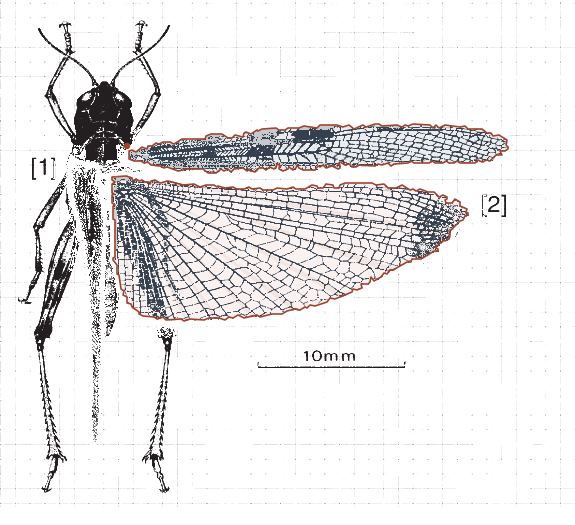
A narrow, hardened forewing lies over a broad hindwing that closes along radial pleats like a hand fan.
Grasshoppers, stick insects, mantids, stoneflies.
Australian plague locust, from the 2003 plate.
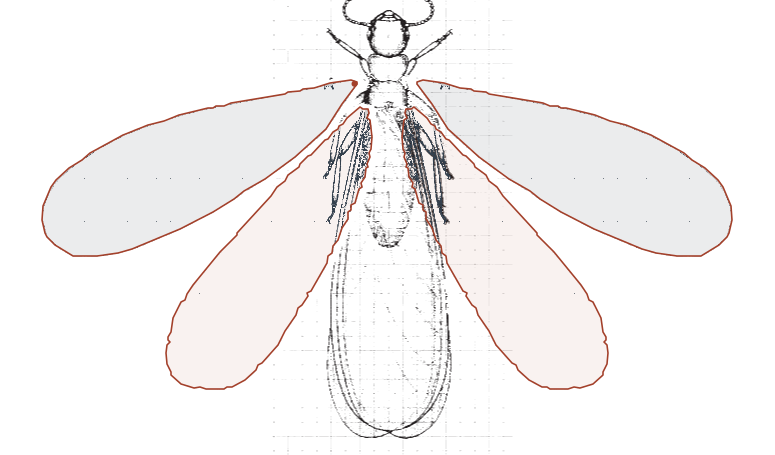
No fold at all. The wings lie flat, one over the other, and swing out from a single root.
Termites, sawflies, bees and wasps.
Termite alate, from the 2003 plate.
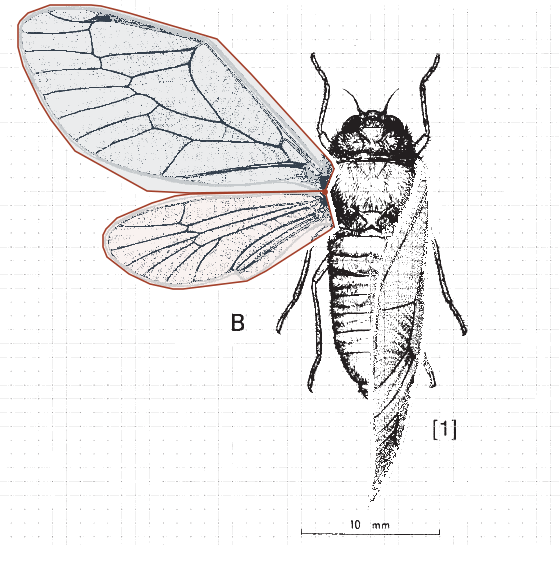
Framed wings rest roof-wise over the body and form its outer envelope. They do not fold; they rotate out to fly.
Cicadas, lacewings, caddisflies.
Eastern bent-wing cicada, from the 2003 plate.
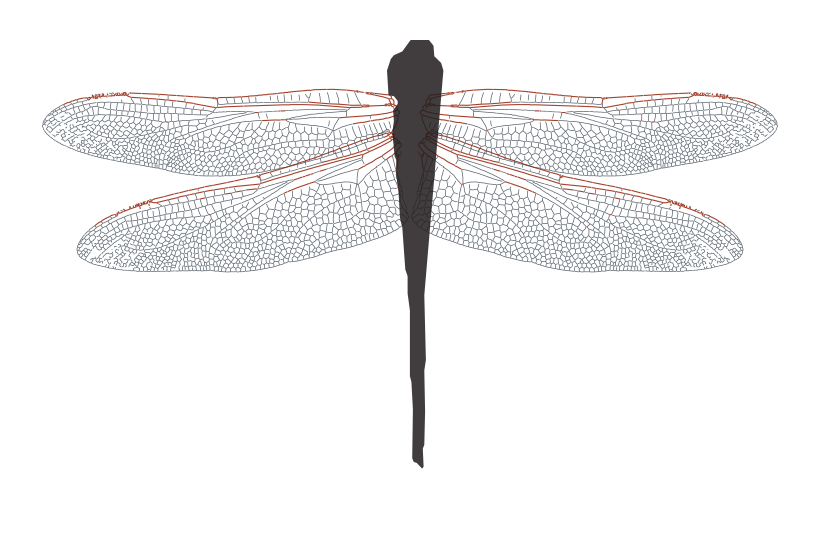
The wings never fold. The baseline every folding type has to beat, and the most precisely controlled wing there is.
Flies and dragonflies.
Venation of the Australian emperor, beating in counterstroke.
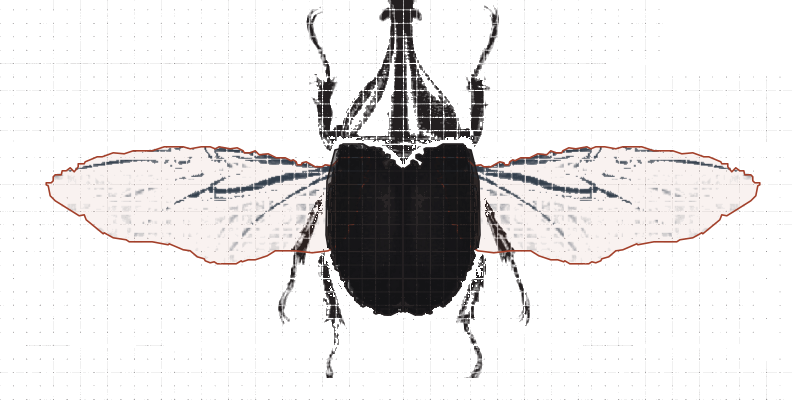
Hard wing cases lift, then a hindwing folded across its length springs open at its crease.
Beetles and ladybirds.
Rhinoceros beetle, from the 2003 plate.
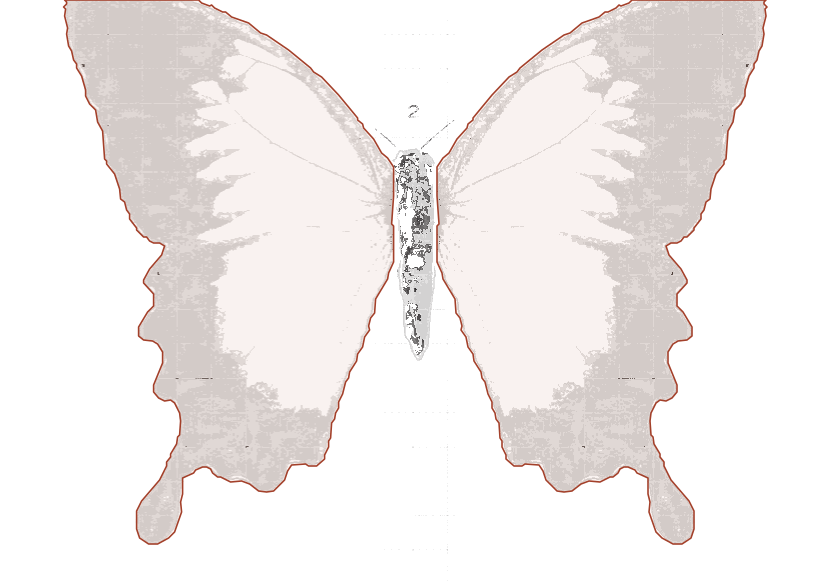
The wings close upright over the back, the smallest stowed footprint of all.
Butterflies and damselflies.
Ulysses butterfly, traced from Tillyard.
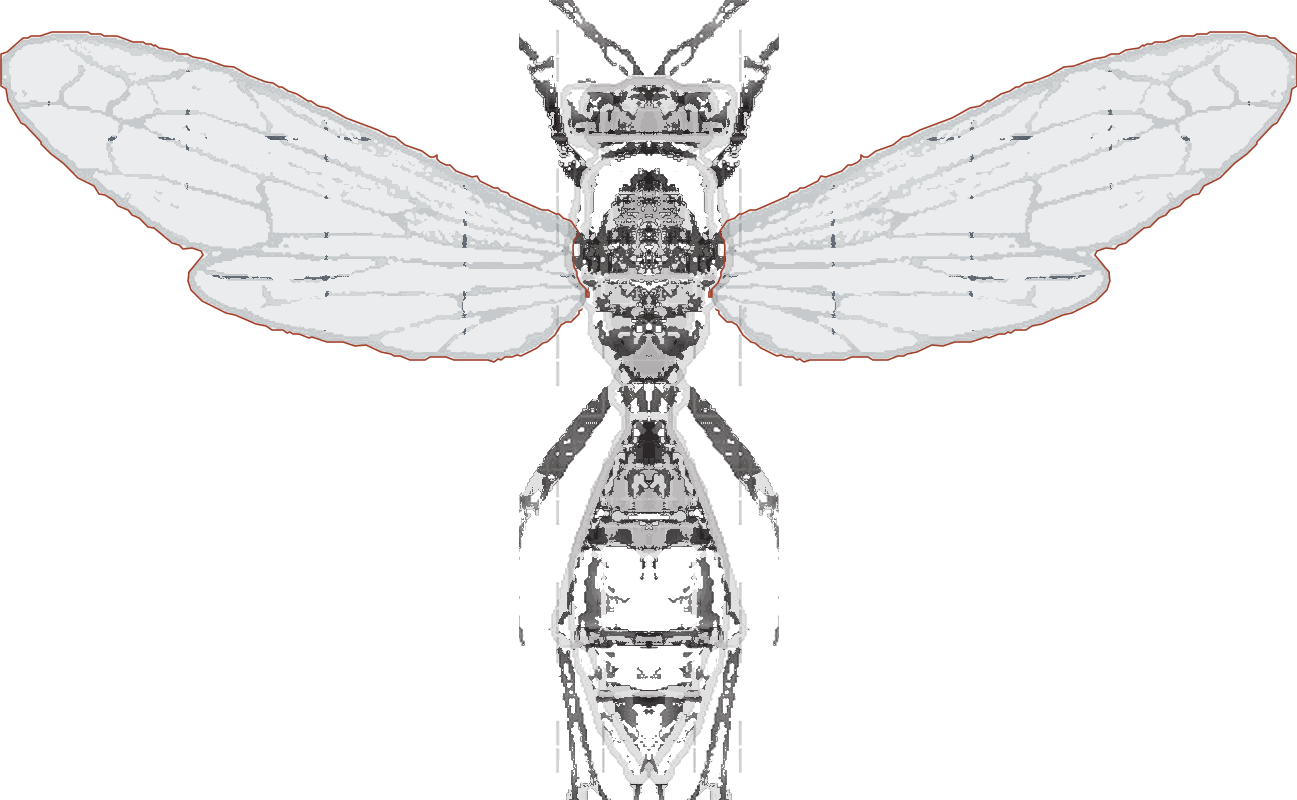
Each forewing folds once along its length. A click at the base gives it two stable positions.
Paper wasps and potter wasps.
Paper wasp, traced from Tillyard.
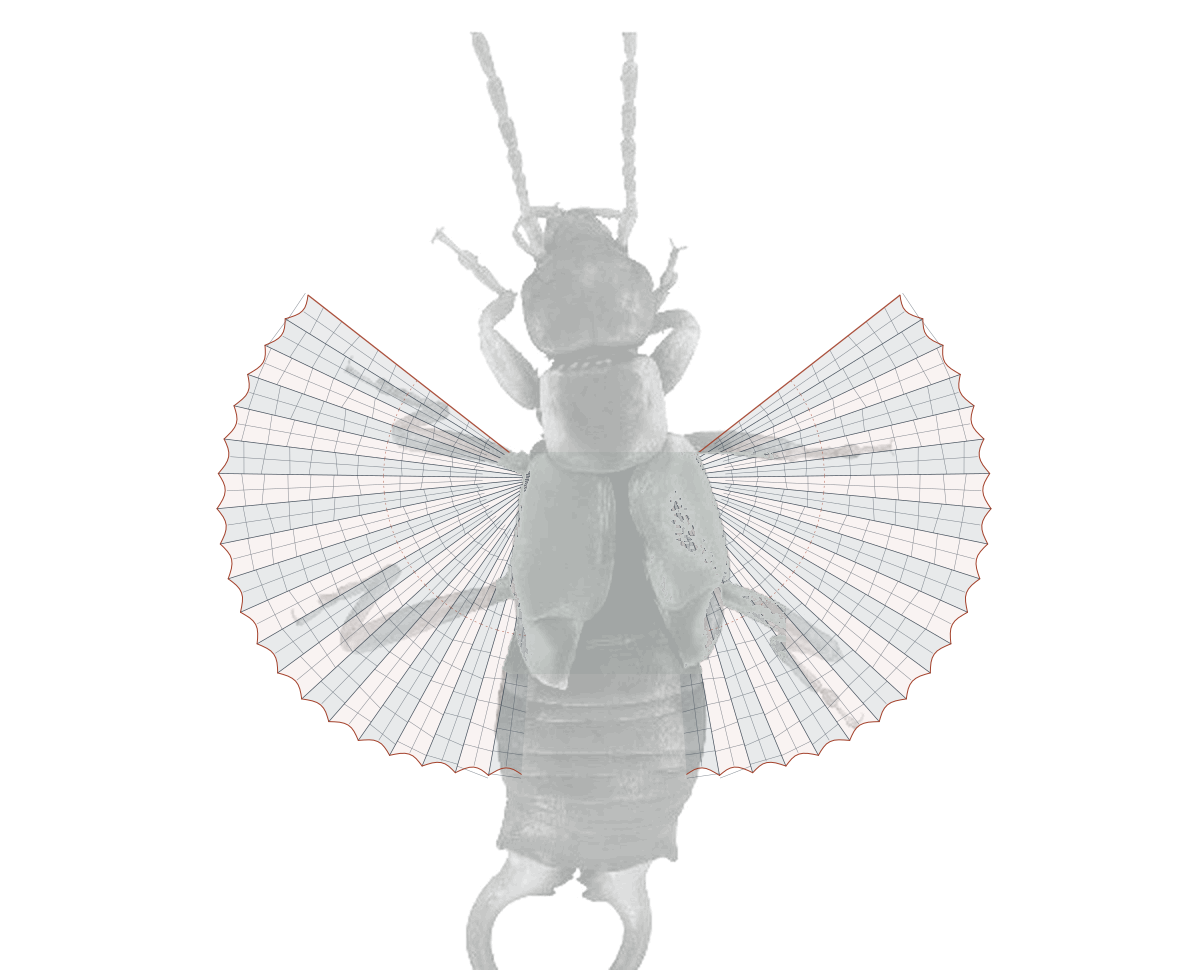
A fan that spreads while its cross-creases snap flat. Bistable: it holds open and shut with no muscle at all.
Earwigs.
European earwig, Insects 360 scan; fan from published ratios.
Six values
A vehicle can behave like an organism: it takes in sunlight, manages its heat by circulating fluid, rests compact and opens when conditions suit it.
Mobility that gathers the energy it uses. Australia has watched solar cars cross from Darwin to Adelaide since 1987; the task is to take that from the race to the everyday.
A product designed this way reads its environment and responds: it opens to the sun, closes against hail and wind, and shelters what it carries from the heat.
Work with sun, wind, heat and landscape rather than overpowering them. Ian McHarg’s phrase; Glenn Murcutt’s “touch the earth lightly”.
In an ecosystem one organism’s waste is another’s food. Things designed this way share energy with each other and with the places they stop.
Beauty is not a finish applied at the end. It is a reason to make things well, and a reason people keep what they own. An insect wing is both useful and beautiful.
A sneak peek
We are building something that gathers its own energy and folds it away when it moves. Stay tuned for 2027.
Open by design
In 2027 we will publish the work behind Mattara under a Creative Commons licence: the theory, the fold atlas and the measurements beneath it, and our design studies and films, free for anyone to read, use and build on.
Ideas like these travel further when they are shared. We are looking for partners in engineering, manufacturing, research and design to carry them from the specimen plate into the world.